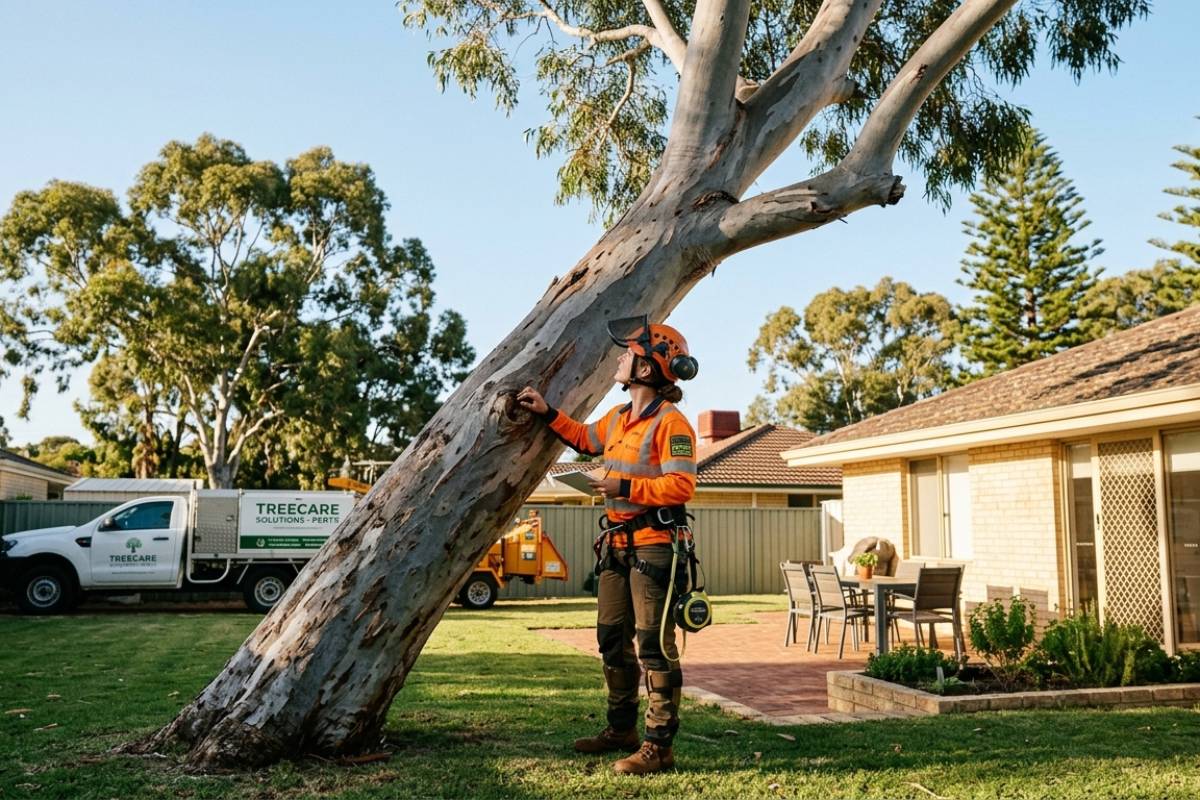
A tree that once gave your property shade and character can become the most expensive thing on your block overnight.
Perth homeowners often sit on the fence about problem trees for months, sometimes years, unsure whether the signs they’re seeing are serious or cosmetic. That hesitation has consequences: the SA Mutual Liability Scheme recorded 2,759 tree-related claims over 20 years, with 55% of those resulting in actual damage or injury from fallen trees or failed branches, according to urban tree management claims data. Most of that damage was preventable with earlier action.
This guide gives Perth property owners a clear framework: how to identify when a tree has crossed the line from manageable to dangerous, what Perth’s council permit landscape actually looks like, and what separates a professional tree removal service from a liability risk. By the end, you will know whether to call an arborist, apply for a permit, or pick up the phone today.
Table of Contents
- Why Tree Removal Decisions Carry Real Risk
- 7 Clear Signs a Tree Needs to Come Down
- Pruning vs Removal: How to Tell the Difference
- Perth Council Permit Rules: What You Need to Know
- What a Professional Tree Removal Service Actually Does
- DIY vs Professional Removal: A Direct Comparison
- How to Choose the Right Arborist in Perth
- Conclusion
1. Why Tree Removal Decisions Carry Real Risk
Trees on your property are your responsibility. If a tree you own falls and damages a neighbour’s fence, vehicle, or home, the liability question lands squarely on you, and your insurance coverage may not protect you if you ignored visible warning signs.
Homeowners insurance typically covers cleanup and damage to structures when a tree falls, but policies generally do not extend coverage to trees removed due to negligence in maintenance or improper removal attempts by untrained individuals.
That legal and financial exposure is exactly why identifying warning signs early and acting through a licensed professional is not optional for Perth property owners.
2. Seven Clear Signs a Tree Needs to Come Down
Dead or Dying Wood
A dead tree does not fall on a schedule. It can stand for years and then fail without warning during a storm, on a still night, or mid-afternoon on a regular Tuesday. Look for bark that peels and does not regrow, brittle branches that snap rather than bend, and an absence of leaves during the growing season.
A partially dead tree is not safer than a fully dead one. Partial dieback often signals root failure, disease spread, or internal decay that is far more advanced than what is visible above the soil line.
Structural Cracks and Split Trunks
Deep vertical cracks in the trunk, co-dominant stems splitting at a V-shaped fork, and large horizontal splits in major limbs are all indicators of compromised structural integrity. These defects reduce the force needed to cause failure, particularly during Perth’s strong summer thunderstorms and Fremantle Doctor wind events.
A split trunk will not heal itself. Left unaddressed, it is a falling hazard waiting for the right conditions.
Disease and Pest Infestation
Fungal conks (shelf-like mushrooms) growing at the base or along the trunk signal active internal decay. This is not surface mould; it is evidence that the tree’s structural wood is being consumed from the inside.
Pest infestations such as wood borers and termites create exit holes, tunnelling through the cambium and heartwood and accelerating internal breakdown. If you see sawdust-like frass at the base, or hear hollow sounds when knocking on the trunk, a professional arborist assessment is urgently needed.
Root Damage and Soil Heaving
Raised soil around the base of a tree, cracked foundations, damaged underground pipes, or a visible lean that developed over a short period are all signs that the root system is compromised or failing. Root problems are particularly common with large eucalypts and Moreton Bay figs in older Perth suburbs.
Root failure does not announce itself loudly. The tree can appear healthy above ground until the structural anchoring system beneath gives way entirely.
Storm or Wind Damage
A tree that has sustained major limb loss, bark stripping, or root exposure during a storm should be assessed by a qualified arborist within 24 to 48 hours. Damaged trees experience elevated stress and secondary failures in the weeks following a storm event.
Not all storm-damaged trees need to be removed. But a professional assessment immediately after the event is the only way to determine whether repair or removal is the right call.
Poor Placement Near Structures
A tree positioned too close to a house, retaining wall, septic system, or overhead power line is a risk that grows with the tree. Structural conflicts between roots and foundations worsen over time and do not resolve without intervention.
If a tree’s canopy now overhangs your roof or its roots are lifting paving slabs, the trajectory of the problem is clear. Removal or significant structural pruning guided by a certified arborist is required.
Significant and Sudden Lean
All trees have a natural lean, but a lean that has increased noticeably over a short period, particularly after heavy rain or wind, indicates root movement or soil instability. A leaning tree near a structure, driveway, or footpath represents an immediate hazard.
The direction of lean matters as much as the angle. A tree leaning toward an occupied structure requires urgent professional evaluation, not a wait-and-see approach.
3. Pruning vs Removal: How to Tell the Difference
Not every problem tree needs to come down. A certified arborist will always assess whether the risk can be managed through structural pruning, crown reduction, or cabling before recommending full removal. The determining factors are the degree of internal decay, the location of the defect, and the target zone (what the tree would hit if it failed).
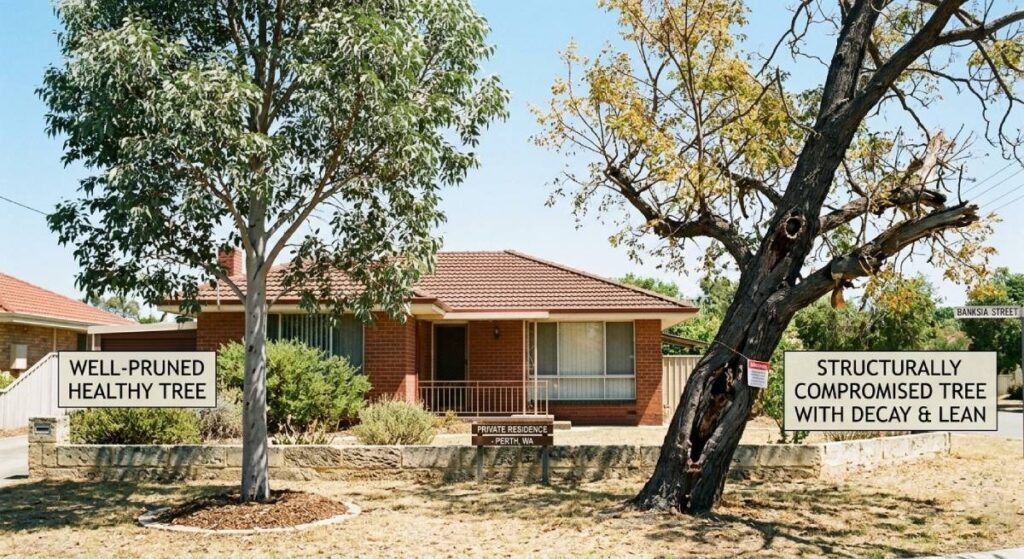
A tree with up to 25% canopy dieback and no root or trunk issues is generally a candidate for pruning and monitoring. A tree with trunk decay, root failure, or a lean toward a structure crosses into removal territory in most cases.
The single most important point: this call should never be made by a homeowner alone. An arborist’s written assessment documents the decision and protects you legally if the situation deteriorates.
4. Perth Council Permit Rules: What You Need to Know
Perth does not operate under a single statewide tree protection law. Regulations are set at the local government level, and they vary significantly between suburbs.
The rules governing whether you can remove a tree on your property in Australia vary significantly between states and local council areas, which is why Perth homeowners should confirm their specific LGA’s planning scheme before any work begins.
Western Australia does not currently have a statewide law that uniformly protects trees on private land. While street trees and trees in public parks are protected under specific council policies, trees on private property often fall into a legal grey area unless a local government policy explicitly regulates them.
Several Perth councils have adopted formal protection policies:
- City of South Perth adopted Local Planning Policy 3.2 in August 2025, requiring development approval before removing or damaging a Regulated Tree on zoned land.
- City of Fremantle follows the WALGA-model Tree Retention Policy, making it an offence to significantly prune or remove mature trees over a certain size without council approval, often requiring two replacement trees for every one removed.
- City of Perth protects street trees under its Tree Protection Policy, though private land rules differ.
In cases where a tree poses an immediate safety hazard, emergency removal is generally exempt from prior approval, but homeowners should document the situation with photos and seek arborist advice.
The practical rule: Before removing any tree in Perth, contact your local council directly, confirm whether your tree falls under a protection policy, and if a permit is required, obtain a certified arborist’s report before lodging the application. Removing a regulated tree without approval can trigger significant fines and mandatory replanting orders.
5. What a Professional Tree Removal Service Actually Does
A qualified Perth tree removal service is not just someone with a chainsaw and a ute. The process for any sizeable tree involves multiple stages of planning, rigging, and controlled dismantling.
Site Assessment
A certified arborist inspects the tree, identifies defects, assesses the drop zone, and determines the safest removal method. This assessment also establishes whether a council permit is required.
Permit Coordination
Reputable arborists handle the council application process and provide the supporting documentation needed for approval, including a written arborist report.
Staged Removal
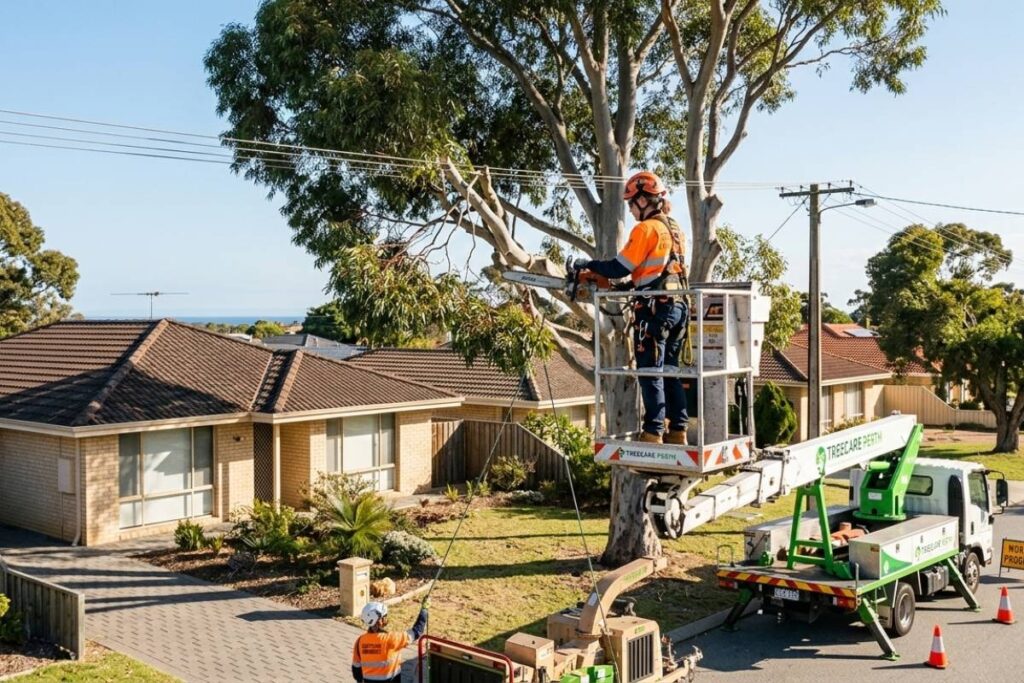
For trees near structures, the crown is dismantled in controlled sections using rigging systems to lower limbs safely. For open-area trees, directional felling may be used.
Stump Grinding
After the trunk is felled, a stump grinder reduces the remaining stump below ground level, eliminating the trip hazard and root system. This is a separate service that should be confirmed before booking.
Removing a tree stump is more complex than most homeowners expect, as root systems can extend two to three times the width of the canopy and require specialised grinding equipment to clear below the soil line.
Site Clearance
All timber, branches, and debris are removed or chipped on-site. A reputable operator leaves the property clean, with paths blown and lawns raked.
Australian data shows that about 65% of tree-related worker casualties occur during felling, and 20% during lopping or trimming, which underscores why proper rigging, planning, and professional equipment are non-negotiable on any removal job.
6. DIY vs Professional Removal: A Direct Comparison
| Factor | DIY Removal | Professional Tree Removal Service |
| Safety risk | Very high; chainsaw and fall injuries are common | Managed through certified training, PPE, and rigging |
| Equipment | Consumer chainsaws; no access to EWPs or chippers | Commercial-grade tools; elevated work platforms |
| Insurance coverage | Home insurer may void claim if DIY damage occurs | Licensed operators carry up to $10M public liability |
| Council compliance | Homeowners often unaware of permit requirements | Arborists manage permit applications directly |
| Cost | Lower upfront, but high risk of property damage costs | National median removal cost approximately $1,740; varies by tree size and location |
| Stump removal | Rarely achievable without specialist equipment | Stump grinding available as part of full service |
| Legal liability | Full personal liability if damage or injury occurs | Contractor liability covered by their insurance |
Understanding how much arborists charge per hour in Perth helps homeowners budget accurately before requesting quotes, particularly when the job involves both full removal and stump grinding as separate line items.
7. How to Choose the Right Arborist in Perth
Check for certification
Look for an AQF Level 3 Certificate III in Arboriculture or higher. In Australia, certified arborists are listed on the Arboriculture Australia or TAFE accreditation databases.
Verify insurance
Any professional you hire should carry public liability insurance of at least $5 million. Ask for a current certificate of currency before work begins. Many home insurers will void a claim if damage occurs during work carried out by an uninsured contractor.
Require a written quote and scope
A reputable operator provides a written quote specifying exactly what is included: removal, stump grinding, debris removal, and any permit coordination. Verbal agreements leave you exposed.
Ask about council permit experience
If your tree is in a regulated zone, your arborist should have direct experience lodging council applications and producing compliant arborist reports.
Avoid pressure to skip permits
Any operator who suggests you skip the council process or claims no permit is needed without verifying your specific council’s rules is a red flag. The fines for unauthorised removal fall on the property owner, not the contractor.
Conclusion
A tree that poses a risk to people or property does not become safer the longer you wait. Perth homeowners who recognise the warning signs early, understand their local council permit obligations, and engage a licensed tree removal service protect both their property and their legal standing. The difference between a managed removal and an emergency callout after a tree has already fallen is, in almost every case, a matter of acting on the signs before conditions force the decision.


