Table of Contents
- Why Hiring the Wrong Tree Cutter Is a Costly Mistake
- The Difference Between a Tree Cutter, Arborist, and Tree Lopper
- Step 1: Check Qualifications and Certification
- Step 2: Verify Insurance Before Anyone Picks Up a Chainsaw
- Step 3: Understand Council Permit Requirements
- Step 4: Get and Compare Multiple Quotes
- Step 5: Spot the Red Flags of a Rogue Operator
- What to Expect on the Day
- Tree Removal Cost Breakdown: What Affects Your Price
- Conclusion
Why Hiring the Wrong Tree Cutter Is a Costly Mistake
A large gum leans toward your roof. A neighbour complains it’s blocking sunlight. Storm season is approaching. You search “tree cutters near me” and get dozens of results with identical five-star reviews, and no idea how to separate a qualified arborist from someone with a chainsaw and an ABN.
That gap in knowledge is where homeowners lose money, lose trees they didn’t have to lose, and in some cases, lose legal protection entirely when something goes wrong on their property.
Safe Work Australia’s Guide to Managing the Risks of Tree Work (March 2023) states plainly that chainsaws “can cause fatal or major injuries, especially if used by untrained workers.” The same guide requires that workers carrying out above-ground tree work hold formal qualifications specific to the type of work performed.
This checklist gives you a structured, no-guesswork process to find a reliable local tree cutter, verify their credentials, and protect yourself at every step.
The Difference Between a Tree Cutter, Arborist, and Tree Lopper
These terms get used interchangeably in search results. They are not the same, and the distinction matters for your safety and your wallet.
- Tree cutter/tree feller: A broad term for anyone who removes trees. No formal qualification is implied.
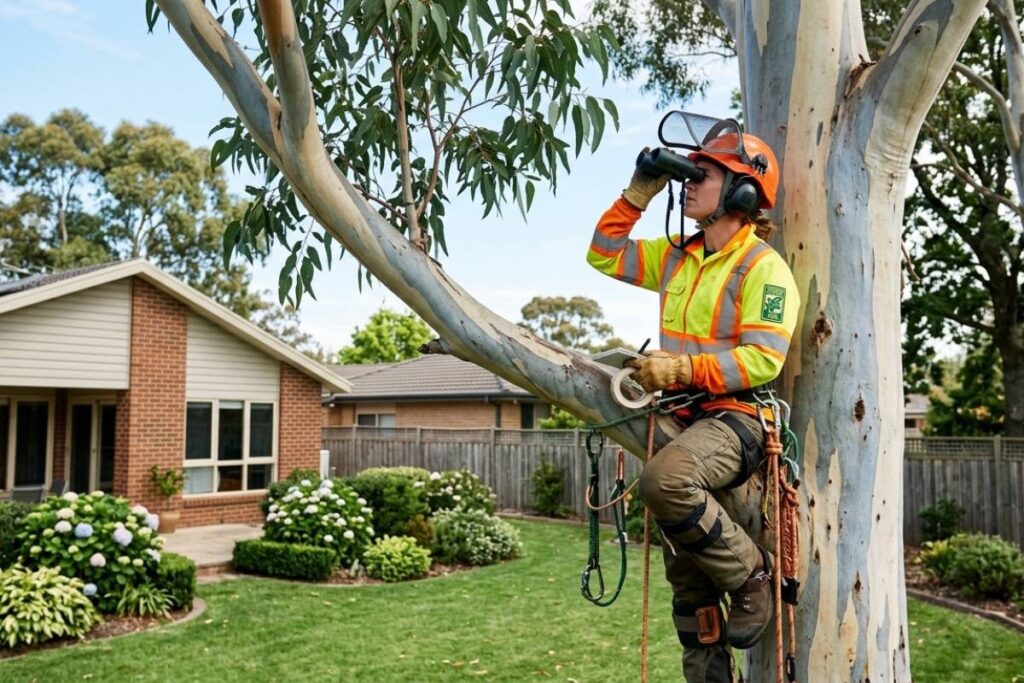
- Arborist: A trained specialist in tree biology, structural assessment, and safe removal. Certified arborists hold AQF-recognised qualifications (Certificate III in Arboriculture at minimum, often Certificate V or higher for complex jobs).
- Tree lopper: Typically performs basic pruning and trimming. May lack the structural knowledge required for full removals.
The distinction becomes especially important on large residential jobs, where the difference between an arborist and a logger determines whether the person on your property has formal training in structural tree assessment or simply experience in felling.
For any job involving a tree over five metres, a tree near power lines, a protected species, or a structurally compromised tree, you need a certified arborist, not just a tree cutter. Always confirm the qualification level before booking.
Step 1: Check Qualifications and Certification
What to look for
The gold standard in Australia is certification through the International Society of Arboriculture (ISA) or registration on the Arboriculture Australia directory. These databases are publicly searchable.
- Ask for the contractor’s AQF Certificate III in Arboriculture at a minimum.
- For complex removals (near structures, power lines, or water mains), look for Certificate V or a Registered Consulting Arborist (RCA) credential.
- Check whether they are a member of. Members are bound by a professional code of conduct.
What to ask
- “What AQF level are your arborists?”
- “Are you ISA-certified?”
- “Can I see your current certification?”
Any reputable operator answers these questions without hesitation.
Step 2: Verify Insurance Before Anyone Picks Up a Chainsaw
This is the single most important box to tick. If an uninsured contractor damages your property, injures a bystander, or is hurt on your land, the financial and legal liability can fall on you.
Two types of insurance you must confirm
- Public Liability Insurance: Should be a minimum of $10 million. This covers property damage and third-party injury claims.
- Workers Compensation Insurance: Covers the crew if they are injured on your property. Without it, you could be sued directly.
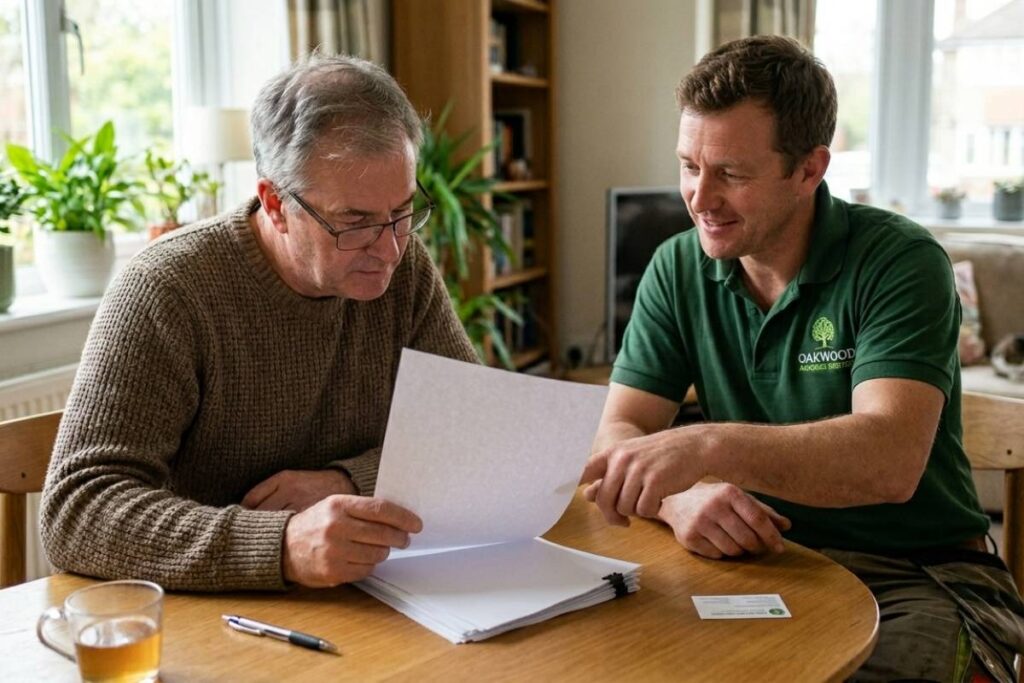
Ask for a Certificate of Currency before work begins. This is a one-page document from the insurer showing the policy is active. Do not accept a verbal assurance or an expired document.
Step 3: Understand Council Permit Requirements
Many Australian homeowners skip this step and pay for it later, either with fines or forced replanting obligations.
Council rules vary significantly by state and local government area, and understanding the broader tree removal laws in Australia before contacting any contractor prevents costly permit violations down the line.
When you likely need a permit
Most local councils require a permit for:
- Trees over 5 metres in height (exact threshold varies by council)
- Trees of a specific trunk diameter (commonly 30cm at breast height)
- Protected species or heritage-listed trees
- Trees in a conservation zone or bushfire-prone area
When you may not need a permit
- Dead trees posing an immediate danger (but check first)
- Invasive species listed on your council’s exempt list
- Trees within a certain distance of approved structures (rules vary significantly)
How to check:
Visit your local council’s website and search “tree removal permit” or “tree preservation order.” Some councils have an online portal where you can enter the tree’s address and species. If in doubt, call the council directly. A qualified arborist familiar with your area should also know the relevant rules and can often help prepare the application.
Step 4: Get and Compare Multiple Quotes
Price alone is not a reliable indicator of quality, but getting multiple quotes protects you from being overcharged and reveals how different operators approach the same job.
Homeowners who compare three or more quotes save an average of 28%. Always ask for proof of public liability insurance alongside any quote.
What a legitimate quote must include
- Species and estimated height of the tree
- Method of removal (felling vs. sectional dismantling)
- Whether stump grinding is included or quoted separately
- Green waste removal and disposal costs
- Any permit assistance fees
- A clear line item for cleanup
A quote that lumps everything into a single number with no breakdown is a red flag. You cannot dispute the scope of work you never agreed to in writing.
Step 5: Spot the Red Flags of a Rogue Operator
The tree services industry in Australia has a known problem with unlicensed operators, particularly after storm events when demand spikes. Knowing what to look for prevents hiring someone who could leave you with property damage, a fine, or an incomplete job.
Red flags checklist
- Approaches you door-to-door or via an unsolicited flyer after a storm
- Demands full payment up front before any work starts
- Cannot provide a Certificate of Currency for insurance
- Gives a quote over the phone without inspecting the tree
- Does not mention council permits for a clearly large tree
- No verifiable physical address or ABN
- Fake or suspiciously templated Google reviews (check dates and reviewer history)
- Pushes you to decide “today” with an expiring discount
If a contractor ticks even two of these boxes, move on. A reliable operator builds their reputation on patience and transparency, not pressure.
What to Expect on the Day
A professional crew arrives with the right equipment for the job scope quoted. Here is the typical sequence for a residential removal:
- Site assessment: The lead arborist walks the site, reassesses hazards, and confirms the plan.
- Setup: Exclusion zones are established, traffic is managed if required, and PPE is worn by all workers.
- Removal: Depending on tree size and access, the tree is felled whole or dismantled in sections from the top down.
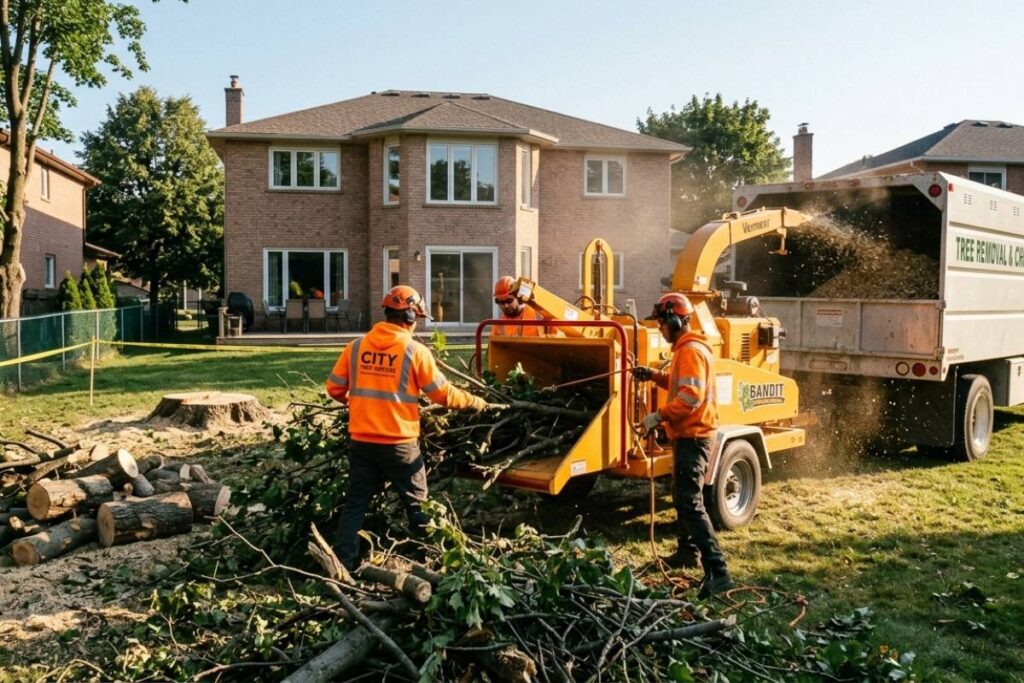
- Wood chipping or cutting: Branches go through a chipper; timber may be sectioned for firewood if you request it.
- Stump grinding: If included in the quote, this happens last.
- Cleanup: All green waste, sawdust, and debris are removed from the property unless you have arranged otherwise.
Confirm with the contractor the night before that nothing has changed with weather conditions or access. Wet ground or high winds may push the job.
Tree Removal Cost Breakdown: What Affects Your Price
No two jobs are priced identically. Understanding cost drivers lets you read a quote critically and negotiate from a position of knowledge.
| Factor | Low Cost Scenario | High Cost Scenario |
| Tree height | Under 6m (small natives) | Over 15m (large eucalypt) |
| Access | Open backyard, driveway access | Tight side passage, steep embankment |
| Location | Away from structures and power lines | Adjacent to roof, fence, or live wires |
| Species | Soft timber (pine, willow) | Dense hardwood (ironbark, grey gum) |
| Health | Live, structurally sound tree | Dead or structurally compromised (unpredictable) |
| Stump removal | Excluded from scope | Included with grinding |
| Season | Late summer / early autumn | Spring (peak demand) |
| Debris removal | Homeowner keeps wood | Full green waste disposal required |
Tree removal in Australia typically costs between $500 and $22,000. Most residential jobs land between $1,500 and $3,500, with species, height, access, and location being the primary cost drivers.
Late summer to early autumn (February to March) is typically the most affordable time for tree removal in Australia. Spring is generally the busiest and most expensive season.
Additional services to budget for separately
- Stump grinding: $70 to $1,200, depending on stump size and species
- Council permit application assistance: varies by provider
- Emergency or after-hours callout: premium rates apply
- Crane hire for complex urban removals: adds high cost
Stump grinding is almost always quoted separately from the removal itself, and why tree stumps are difficult to remove, particularly deep-rooted hardwoods, explains why the cost range of $250 to $1,200 can catch homeowners off guard.
Conclusion
Finding reliable tree cutters near you comes down to verifying three non-negotiables before you sign anything: current certifications, active insurance with a Certificate of Currency, and a clear written quote that covers the full scope of work. Use this checklist as your filter, check council permit requirements early, and collect at least three quotes to protect both your budget and your property.