
Australia has been reading news bulletins for over 170 years. But the format that once arrived folded on a doorstep now lands as a push notification on a locked screen.
The shift matters because the bulletin is not just a delivery mechanism. It is the primary way Australians have decided what is worth knowing. From colonial broadsheets to algorithmically curated news feeds, the bulletin has always been a trust contract between publisher and reader.
That contract is now under renegotiation. Australian newspaper publishing industry revenue is projected to contract at an annualised rate of 5.2% over the five years through to 2025-26, falling to $2.8 billion, including a 6.8% slump in the current year alone.
Understanding how the bulletin evolved is the only way to understand where it is going.
What Is a Newspaper Bulletin?
A newspaper bulletin is a concise, published report on current events, typically time-sensitive and intended for immediate public consumption. It differs from a feature or editorial in that speed and factual density take priority over narrative depth.
In Australian publishing history, bulletins ranged from single-sheet war dispatches to front-page news summaries. The format prioritised brevity, authority, and distribution reach. Those three values still define the best digital bulletins today.
Origins of the Bulletin Format in Australia
The first Australian newspapers emerged in the early 1800s, with The Sydney Gazette and New South Wales Advertiser launching in 1803 as the colony’s first publication. Early bulletins served a dual purpose: government notice board and public record.
By the mid-1800s, competitive commercial presses in Sydney, Melbourne, and Adelaide were printing daily bulletins that reported shipping arrivals, gold rush developments, and parliamentary proceedings. Speed was already the differentiator. The paper that broke a story first won readers for that edition.
The bulletin format was never designed for long reads. It was designed for decision-making. Merchants needed prices. Citizens needed laws. Communities needed court results. That purpose has not changed.
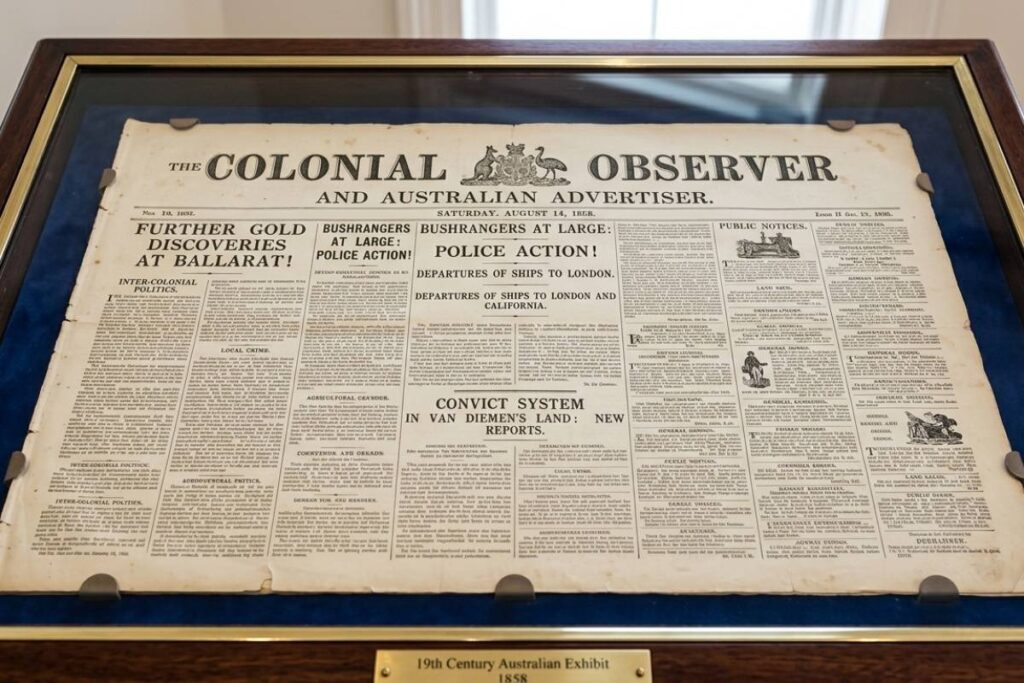
How Print Bulletins Defined Australian Public Life
For most of the 20th century, the morning newspaper bulletin was the first media contact Australians had with the world. Radio came later, television later still, but the printed bulletin remained the record of authority. Court cases, election results, and company announcements were not “real” until they appeared in print.
The newspaper bulletin also shaped Australian regional identity. Publications like The Bulletin magazine, founded in 1880, created a distinct national literary and political voice during a period when Australia was still defining itself as a federation. The bulletin format, applied at a national scale, became a tool of nation-building.
Advertising subsidised this entire system. Classified sections, display ads from department stores, and public notices kept cover prices low and circulation high. The bulletin was a commercial product disguised as a public service.
The Digital Disruption: When the Bulletin Moved Online
The structural shift began in the mid-1990s when Australian mastheads began publishing online. Most treated the web as a free supplement to the paid print edition. That decision seeded a revenue problem that still hasn’t been fully solved.
Classified advertising, which had funded newsrooms for decades, collapsed first. Websites like Seek, Domain, and Carsales stripped out the profitable sections that had bankrolled investigative reporting, foreign correspondents, and bulletin distribution infrastructure.
By the 2010s, digital subscriptions became the survival strategy. The Sydney Morning Herald, The Australian, and the Australian Financial Review all erected paywalls. The bulletin format adapted: instead of one edition per day, publishers now push multiple bulletin updates across mobile apps, email newsletters, and social platforms around the clock.
Print vs. Digital Bulletins: A Direct Comparison
| Feature | Print Bulletin | Digital Bulletin |
| Publication frequency | Once or twice daily | Continuous / real-time |
| Distribution reach | Geographically limited | National and global |
| Reader engagement | Linear, start-to-finish | Non-linear, link-driven |
| Revenue model | Advertising + circulation | Subscriptions + programmatic ads |
| Archive access | Physical libraries | Searchable online databases |
| Update capability | No corrections until next edition | Updatable within minutes |
| Reader analytics | Estimated via audit | Precise via click and scroll data |
| Environmental cost | High (paper, ink, logistics) | Lower, but rising (data centres) |
Major Australian Publications and Their Bulletin Evolution
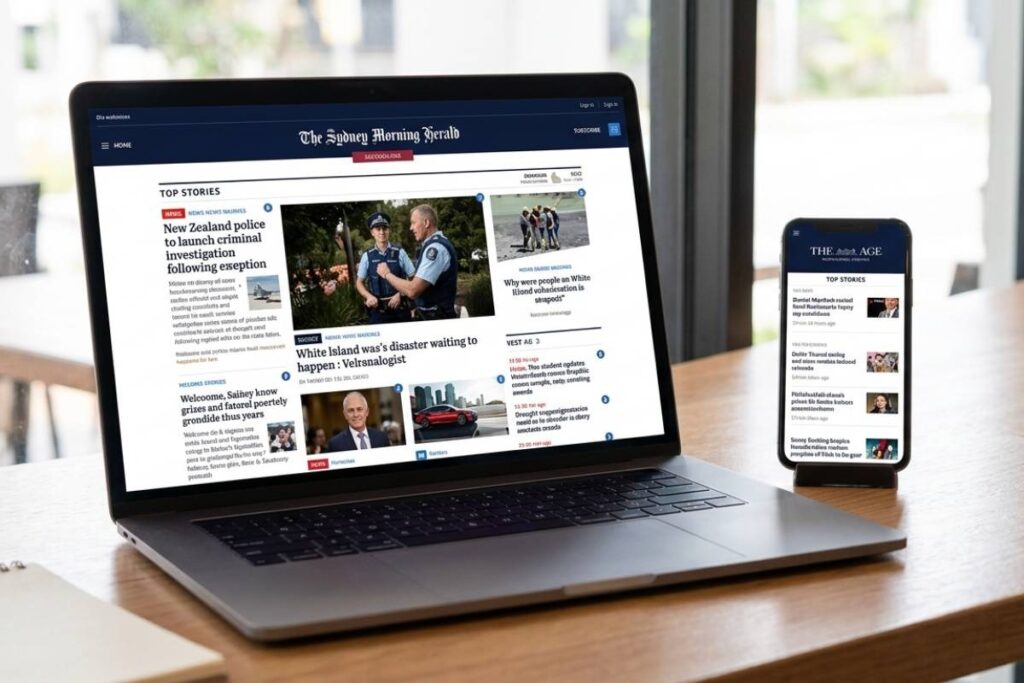
The shift from print to push notification is most visible in iconic mastheads, with theSydney Herald front page long serving as the benchmark for how Australian editors prioritised stories for public consumption.
News Corp Australia
Operates the Herald Sun, Daily Telegraph, The Australian, and Courier-Mail, all of which now run digital-first bulletin strategies. News Corp accounts for over 60% of total metro print engagement in Australia, while simultaneously driving the country’s most aggressive digital subscription push.
Nine Entertainment
Controls the Sydney Morning Herald and The Age, whose digital-only subscriptions have grown to the point where they now surpass print-and-digital bundle subscribers.
Seven West Media
Holds The West Australian, which despite being reportedly the most expensive and best-performing daily newspaper in the country, still saw subscriptions fall as the broader structural decline continued.
Regional and community bulletins face the steepest challenge. Four conglomerates, including News Corp Australia, Nine Entertainment, Seven West Media, and Australian Community Media, control 84% of newspaper revenue, leaving independent local bulletins fighting for a shrinking advertising pool.
The Role of News Bulletins in the Age of Social Media
Facebook, Twitter/X, and TikTok did not replace the newspaper bulletin. They replaced the distribution of it. The bulletin content itself still originates from professional newsrooms. What changed is the context around it.
When a bulletin item gets shared on social media, it loses its original framing, authorship signal, and editorial hierarchy. A paragraph ripped from a 1,200-word analysis reads very differently than the same paragraph inside the full piece. This is where the credibility of the bulletin format has eroded most sharply.
Australian publishers have responded with newsletter products that reconstruct the editorial bulletin experience: curated, sequenced, authored, and delivered directly to an inbox. Products like The Guardian Australia’s morning briefing or Nine’s Need to Know operate on the same trust architecture as the original morning bulletin, just through a different pipe.
What Defines a Credible Digital Bulletin Today
Google’s E-E-A-T framework now functions as the digital equivalent of the masthead. A bulletin without these signals ranks poorly and converts readers poorly.
For an Australian digital bulletin to carry weight, it needs bylined journalists with verifiable track records. It needs source transparency, especially on political and economic stories. It needs corrections policies that are visible, not buried. And it needs institutional backing that signals editorial independence.
The Australian Bulletin format, applied digitally, has one structural advantage legacy mastheads lack: agility. A focused, credible digital bulletin can publish, update, and correct faster than a multi-section broadsheet operation. That speed, paired with editorial rigour, is what builds the reader trust that search engines reward and audiences return for.
Conclusion
The Australian newspaper bulletin has never been about paper. It has always been about trust, speed, and public relevance. As print revenue contracts and digital platforms restructure how Australians consume news, the core bulletin value proposition remains unchanged: give readers accurate, timely information they can act on. Publishers who understand that the format is the product, not the medium, are the ones building audiences that last.